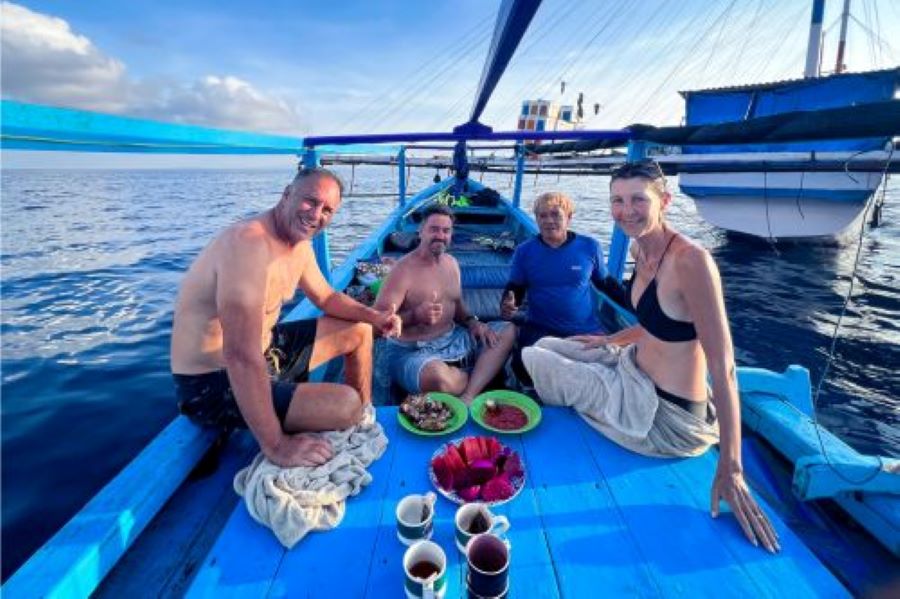
I still remember the sensation—drifting above coral gardens near Saleh Bay, heart racing as a majestic shadow emerged in the blue. There it was: a whale shark. Silent. Massive. Graceful. It moved like a dream, indifferent to our tiny presence. That moment defined my trip to Sumbawa. But what came after it, surprisingly, defined my love for this island.
Because once you’re out of the water, still dripping salt and sun, something primal kicks in—hunger. Real hunger. And if there’s one thing Sumbawa does just as beautifully as snorkeling, it’s feeding you afterward. In a way that feels earthy, honest, and unforgettable.
After my first day out on the boat with the Saleh Bay whale shark tour, I didn’t expect lunch to be a highlight. I thought the peak had already come and gone with the ocean giants. I was wrong.
Our boat docked along a quiet beach framed by coconut palms and volcanic rock. Smoke was rising gently from a cluster of driftwood fires, and a group of locals—who I later learned were friends of the boat crew—were already grilling something over the flames. The smell hit me instantly. A mix of char, lemongrass, and sea breeze. I was hooked.
Someone handed me a woven palm plate. On it: grilled mackerel still sizzling from the fire, a scoop of warm rice shaped by hand, and a generous dollop of sambal made with tomatoes, shrimp paste, lime juice, and a level of chili heat that could reset your entire nervous system. It was exactly what I didn’t know I needed.
There’s something about post-snorkeling meals in Sumbawa that connects directly to the experience you just had. You’re not being fed for pleasure alone—you’re being grounded again. Pulled back from the dreamy weightlessness of the sea into the grounded, smoky, spicy, soul-filling flavors of the island.
After that meal, I started paying more attention. What did people eat after fishing trips? After paddling across the bay? After hours spent under the sun and water?
The next morning, after another swim with the sea creatures, I wandered inland to a village called Kilo. A small open-air eatery had just begun serving breakfast. They were making tapa kolo—smoked rice traditionally cooked in bamboo tubes over an open fire. The scent of it was nutty, a little like roasted chestnuts, and it was served with shredded coconut and strips of grilled squid. Simple, hearty, and shockingly good.
Locals explained to me that tapa kolo is more than food. It’s an energy source, traditionally eaten after hard work—harvesting, fishing, diving. That made sense. It felt like eating something ancient and powerful.
Another afternoon, I joined a group of young guides at a roadside stall after a long swim session near Mojo Island. They ordered sate pusut, skewers of minced tuna and coconut, wrapped around lemongrass sticks and grilled slowly. The texture was soft, almost creamy inside, with a lightly crisped edge from the fire. Each bite was a mix of ocean and earth—exactly like the island itself.
One of them turned to me and said, “This is our protein shake,” and laughed. He wasn’t wrong. After hours in the water, your body doesn’t just want calories—it craves something elemental. Something warm and alive. That’s what Sumbawan food delivers.
Snorkeling trips, especially near areas where whale shark sightings are common, like around Saleh Bay, tend to start early in the day. By the time you’re back on land, it’s usually late morning or early afternoon. That’s the perfect time to find the true post-snorkeling feasts—when the grills are fired up, the rice is fresh, and people gather to eat under trees, on porches, or straight on the sand.
One day, I skipped the hotel breakfast and headed to Labuan Kenanga, a small port town where fish is traded almost before the sun rises. I stumbled upon a woman frying pepes ikan—fish wrapped in banana leaves, steamed with turmeric, basil, and green chili. It was delicate but deeply flavorful. She handed it to me with sticky rice and fresh cucumber slices. I sat on a plastic stool, surrounded by the sound of fishermen shouting prices and children running barefoot, and felt more connected to the place than ever before.
That same afternoon, someone offered me kerupuk kulit ikan, crispy fish-skin crackers dipped in warm sambal terasi. I kept eating them even though my lips were burning. They’re the perfect post-swim snack: salty, crunchy, unapologetically intense.
Another day, after a trip focused on marine life observation near the quieter corners of Sumbawa, I was invited to a local family home. No restaurant. No signage. Just a house with a large clay stove out back. We had singang, a sour fish soup made with tamarind, ginger, and lemongrass. It was brothy, aromatic, comforting—like the sea in soup form. It soothed the salt in my throat and brought warmth to my sun-chilled bones.
What I started to see was a pattern. There is a rhythm between sea activity and food in this part of the world. It’s not transactional—it’s ritual. It’s cultural. After hours submerged in marine beauty, locals don’t turn to processed food or sugary drinks. They turn to spice. To fish. To fermented sambals and hearty rice. It’s a lifestyle shaped by necessity, but perfected by tradition.
I even noticed the drinks reflect this philosophy. Instead of soda or bottled energy drinks, I saw people sipping young coconut water with lime and honey, or warm ginger tea known as teh jahe. These drinks hydrate, calm the stomach, and help the body adjust after time in the water.
Sumbawa has its own rhythm. It doesn’t rush. The sea teaches patience. And the meals mirror that.
There’s also a joy in the way people eat here. Post-snorkeling meals are rarely solitary. You sit in circles. Plates are shared. Jokes are cracked. No one eats quickly. You recover together. You reflect together. Sometimes, you fall into silence, letting the spice and salt work their magic.
Back in Labuan Jambu, after my final swim of the trip, I sat down for dinner with the same boat crew that had taken me to see the whale sharks on Day One. We had nasi campur laut—rice with a mix of small grilled fish, seaweed salad, coconut-fried tempeh, sambal matah, and boiled eggs marinated in soy sauce.
It wasn’t curated or plated. It was scooped from bowls and passed around the circle. We ate until we couldn’t eat anymore. We talked about the giant fish we saw. We joked about who got sunburnt the worst. We made plans to return.
One of the guides looked up at me mid-meal and said, “The sea gives you appetite, but the land gives you strength.” That line stayed with me.
Travelers come to Sumbawa for many reasons. For pristine coral reefs. For the surreal experience of swimming alongside marine creatures the size of minibuses. For the quiet, less-developed charm that still feels like a secret. But it’s the flavor of the land—the food, the sharing, the smoky simplicity—that completes the experience.
If you ever find yourself on a boat in the turquoise waters of Saleh Bay, eyes wide as a gentle whale shark floats by, just know that the story doesn’t end when the engine turns off and the boat docks.
That’s when the island invites you to the table. When your salt-dried hands reach for grilled fish and rice, when you bite into something spicy enough to make your forehead sweat, when you share smiles with strangers over banana-leaf plates—those moments are just as nourishing as the sea.